
Since Inception the ZADT has been providing technical assistance to the various levels of actors participating in its disbursement model either directly or through its partner institutions. Financial institutions were capacitated in areas which enhanced their understanding and management of credit to small to medium enterprises (SMEs) particularly within the agricultural sector. Other capacity building areas included opportunities in agricultural lending, real life applications of value chain models, risk management in value chain financing, gender in agricultural finance and enhancing value chain development.
Under the current financing model ZADT facilitates provision of technical assistance to value chain actors which include the funded agribusinesses and SMEs and the linked smallholder farmers. Some trainings may be outsourced or requested from partners with the expertise. The ZADT continues to mobilize resources for this activity as well as partnering with other organizations working in the same development space who are working for the uplifting of smallholder agriculture.
Zimbabwe has continued to experience social and economic crisis in the backdrop of climate change as well as poor economic development leading to the high levels of poverty. More specifically, women and youth who constitute 52% and 67% of the population respectively, are disproportionately affected by high levels of unemployment and financial exclusion among other militating conditions. Additionally, limited credit history, lack of collateral, and inadequate financial literacy are significant barriers faced by women and youth. Within this background, having interventions that women and youth have access to a diverse range of financial products and services for income-generating activities becomes critical.
To deepen support to women and youths, who have traditionally been excluded in accessing finance, ZADT developed the CAUSEWAY project with funding from the Embassy of Sweden in Zimbabwe. ZADT built on the afore-mentioned linkages, achievements and key lessons learnt in considering the design and collaborative structure of the CAUSEWAY Project. This project was launched on the 1st of August 2023 in Harare and was officially opened by Dr Matsche, the Deputy Governor of the Reserve Bank.
Overall, the purpose of the project is to improve access to finance for youth and women in peri-urban and rural areas of Zimbabwe to undertake and implement projects that improve and increase their household incomes and food security. The project is targeting to capacitate 6,000 youth and 5,000 women entrepreneurs over a three-year period from June 2023 to May 2026. The project also seeks to capacitate and mentor 300 final year students from selected tertiary agricultural colleges.
The project targets inclusive and sustainable development of the following value chains; Beef/Dairy, Non- Timber Forestry Products, Small Livestock (goats, piggery, sheep etc), Poultry (broilers, layers, and road runners), Traditional Grains, Oil seeds (groundnuts, chia, sesame, sunflower etc) and horticulture value chains (fruits, vegetables, fruits, herbs, and spices) etc. The capacity building programme will include training in entrepreneurship, financial literacy and access to finance. The capacitated women and youth entrepreneurs will be assisted in developing bankable business plans and then linked to financial institutions for access to finance.
The CAUSEWAY Project will be implemented in several provinces around the country. These provinces were selected through a value chain corridor approach. ZADT has recruited six (6) field Officers who will be facilitating the training and mentorship of target women and youth businesses in these areas. The target areas for the project are rural and peri-urban areas of Zimbabwe
ZADT is facilitating the Youth-Led MSME Training and Mentorship project implemented by the African Guarantee Fund (AGF) with funding from the African Development Bank (AfDB) Youth Entrepreneurship Innovation Multi Donor Trust Fund (YEI MDTF). This project is working with 100 startup and growth-oriented youth MSMEs throughout the country, 50% of who are women. The programme is capacitating the MSME youth in entrepreneurship, financial literacy and access to finance. The YEI MDTF programme is supporting youth-owned businesses in various sectors.
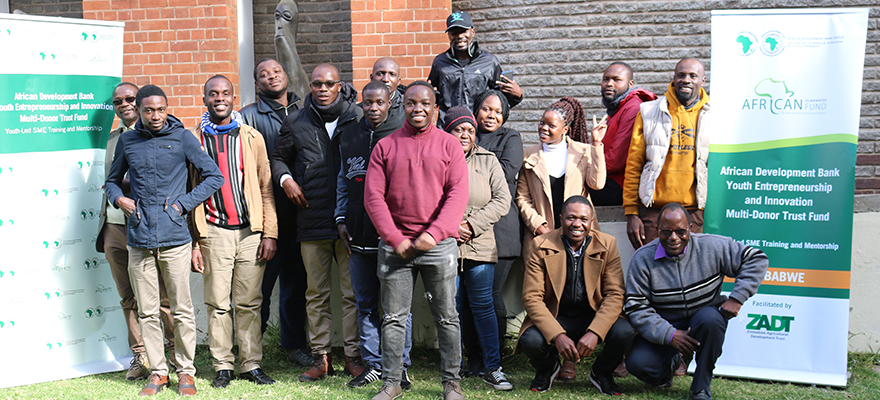
The current group is involved in businesses in agriculture, food processing, consultancy, Information technology, transport, renewable energy, photography, commodity trading and others. Following the completion of the training programme ZADT is currently mentoring the entrepreneurs. The final outcome is a capacitated entrepreneur who can attract funding from financial institutions such as commercial banks, microfinance institutions and other financing houses.
The Food for Export Masterclass 2020 (FEM2020) Programme was a collaborative programme between the Netherlands Embassy in Harare together with the Zimbabwe Agricultural Development Trust (ZADT), Hivos, ZimTrade and PUM, a Dutch Senior Experts organization. The program was working with 15 women entrepreneurs. It was customized and highly focused offering trainings on creation of agricultural value chain based bankable business plans, production methods and certification. Networking skills and personal development of the targeted women entrepreneurs was also inculcated to ensure the entrepreneurs have the confidence to lead, take risks and to innovate.
The Entrepreneurs that were capacitated are involved in the horticulture, agri-food, processed foods and dairy sectors. Specific value chains include dairy, honey, horticulture, nuts, fruits, Chia and herbal teas. Some of the entrepreneurs were already exporting whilst others were working towards that.